Thursday, August 4, 2022

A Link to the Past (Hanging from Your Wrist)


I expected I would soon be one of the “wallflowers” sitting by those very walls, despite Dickon’s stammered request for a dance. He had been teasing me for years, and doubtless his invitation was another of his jests. If I acted as if I thought he had meant his request to dance with me, would he laugh? I resolved to be very cool towards him so he would not do so. 

A Buss from Lafayette, © 2016 by Dorothea Jensen, Chapter 23 


A dance card from Houltonmuseum.org


It recently occurred to me that when I wrote this scene, I left out an "artifact" that would have been  present at most dances in the 19th C. And I should NOT have forgotten it, as this was an artifact that was still around when I started going to dances a century and a half later. 

What am I talking about? DANCE CARDS. These were printed and handed out to young ladies at the beginning of the evening. All the dances would be listed, with a space opposite where a young man could write in his name, if so permitted and accepted by the young lady. (I can't help wondering how the young men kept track of the dances they had promised.) 

Anyway, when I went to high school many, many years ago, dance cards were still given to the girls attending a formal dance. By that time, however, she only danced with her date, so one ever wrote in the dance cards! I was still happy to hook one around my wrist and enjoy the link to the past! 

I am delighted that I will be able to insert the missing dance card into the dramatization of this scene I am writing for performance during the upcoming Lafayette Farewell Tour Bicentennial!

Tuesday, May 31, 2022

Washington Chasing the Guide at the Battle of Brandywine


I found this picture at the yesteryearnews website. It is entitled:

Washington and his Staff Following a Guide Across Country at the Battle of Brandywine, September 11, 1777.

 It shows Washington madly chasing the guide who is leading him to where the British outflanked the American line. It was created by Arthur E. Becher as an illustration for the 1910 book,  On the Trail of Washington; a Narrative History of Washington's Boyhood and Manhood, Based on His Own Writings, Authentic Documents and Other Authoritative Information, by Frederick Trevor Hill. 

Below is how I described this scene in my novel The Riddle of Penncroft Farm:


Squire Cheyney handed me Daisy’s reins with a warning to waste no time, then rushed away with the aide. By this time the gunfire was quickening, making Buttercup as skittish as an unbroken filly. I was still trying to get up on her when General Washington himself emerged from the house, calling for a guide to lead him to Birmingham Road.

I half hoped and half feared that I would be that guide, but instead his aides brought up an elderly man from the neighborhood, Mr. Joseph Brown. Old Mr. Brown made every possible excuse not to go, but in the end was convinced at swordpoint where his duty lay. When he protested his lack of a horse, one of Washington’s aides dismounted from his own fine charger.

As Brown reluctantly climbed into the saddle, Washington sat impatiently on his own beautiful white horse. The instant the frightened farmer was in place, Washington snapped a whip at the rump of the reluctant guide’s horse, which leaped into a gallop. The general followed, spurring his own mount until its nose pushed into the leader’s flank like a colt suckling its mother. “Even this didn’t satisfy Washington, who cracked his whip and shouted, “Push along, old man, push along!” Spellbound, I watched the two race up the hill across the golden fields, jumping the fences as they came to them. I had never seen such horsemanship—superb on the part of the general, dreadful on the part of Mr. Brown. Behind them ran a ragged line of soldiers, rucksacks bobbing as they sped over the uneven ground.


Excerpt From: Dorothea Jensen. “The Riddle of Penncroft Farm.” Apple Books. 


I would like to point out that the fence in the picture appears to be a stake-and-rider fence, mentioned elsewhere in the story. The rider behind Washington on the left side has red hair, so I choose to believe it is supposed to be Lafayette. Mr. Brown, does not look old enough to be an accurate depiction of the reluctant guide, however!


Sunday, March 27, 2022

That last pizza piece could leave you single!!

I love reading the posts on the New England Historical Society website. They are always interesting and registration is FREE!  

This was an interesting account of New England superstitions relating to finding a spouse.

https://www.newenglandhistoricalsociety.com/cabbages-and-biscuits-new-england-superstitions-about-choosing-a-husband/

One of those included was this:

  • If a young man at the supper-table or at a party takes the last biscuit on a plate, he will be an old bachelor. The young woman who does this is likewise fated to live single.

A version of this was still around when I went to college, which was that a girl who took the last piece of a pizza would end up an old maid. (Although it never stopped me from doing so.)

I don't know if I knew about this superstition because my family was from New England, or whether this was also current in the Midwest.

Does anyone ese remember this superstition?


A great new review from a Readers' Favorite Reviewer!


 ". . .a charming coming-of-age novel. Jensen's admiration for Lafayette and other Revolutionary War heroes is reflected in the rich historical details and her meticulous research. Clara is a well-written and nuanced character. Her struggles are relatable and her relationships with the other characters are realistically written. This is a great read for any young history lover."

—Heather Stockard, Readers' Favorite

Monday, January 24, 2022

As clear as the Liberty Bell : )


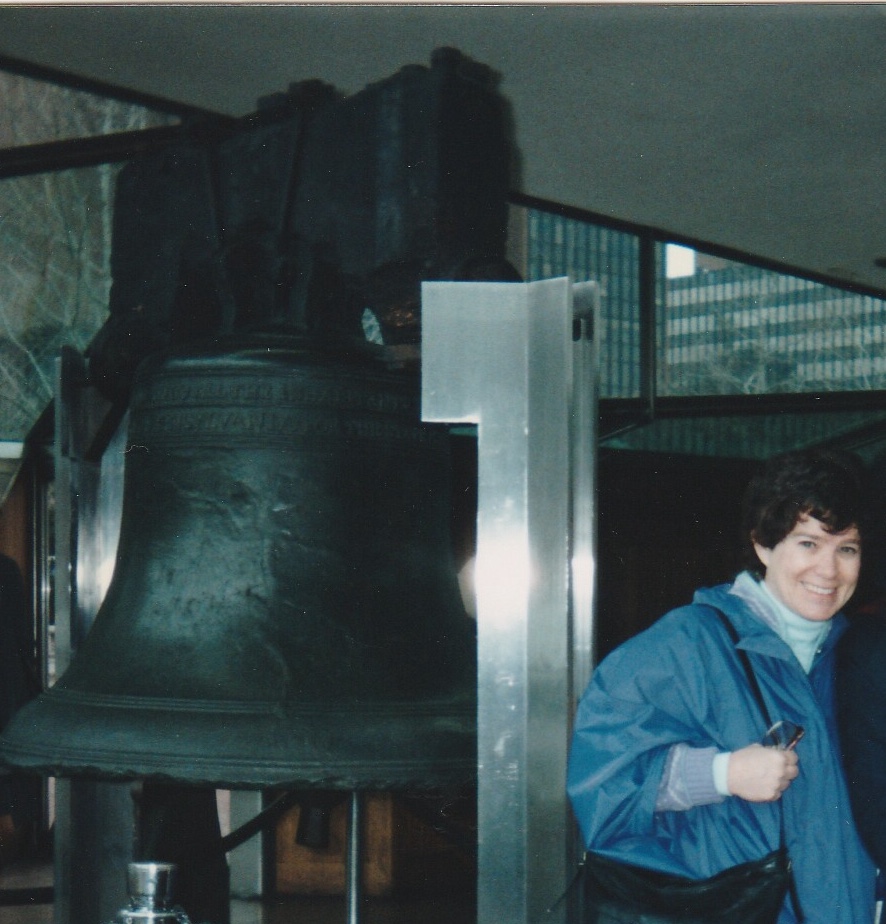
I just came across this picture of me with the Liberty Bell, taken in the early 1990s. When I saw it, it made me think of something a recent reviewer said about my rhyming biography, Liberty-Loving Lafayette: How "America's Favorite Fighting Frenchman" Helped Win Our Independence:

"It’s as clear as the Liberty Bell that Dorothea Jensen breathes the history of our colonial period, and her reverence for and joy in the subject will inspire anyone who opens her superb presentation." —Jon Michael Miller, Readers’ Favorite

Woo hoo!

Another "Duh" Moment Regarding THE RIDDLE OF PENNCROFT FARM

Can you believe that it never occurred to me that settles were helpful in keeping people warm?????

Here's how:

"In sitting before an open fire it was often complained that while one was roasted in front he was frozen in the back and this led to the use in nearly every family of a long seat made of boards called a "settle," with a high back to keep off the wind from behind, which, when placed before the fire, was usually occupied by the older members of the family."

Dow, George Francis. Every Day Life in the Massachusetts Bay Colony (Kindle Locations 1599-1601). bz editores. Kindle Edition.


Here's how I used "settles" in The Riddle of Penncroft Farm, which I am holding as I sit in a settle in the picture above, taken at the City Tavern in Philadelphia.

I cleared and wiped the table, then swept the plank floor while Aunt Cass did the dishes. Then she picked up a sweater and put it on. 

“Better wear your jacket,” she said. “Sandra put it in one of the settles last night.” 

“Huh?” “The settles—those high-backed benches. The seats open up. That’s where I keep hats and mittens and things.” 

I flipped open one of the wooden benches. My jacket was inside. “It looks like my coat is already settled in,” I punned. 

“You’re a punster—good,” remarked Aunt Cass without a glimmer of a smile. “Always liked puns; never much good at making ’em up. Come on.” She pushed open the door and we went outside.

Jensen, Dorothea. The Riddle of Penncroft Farm (Great Episodes) (p. 23). Houghton Mifflin Harcourt. Kindle Edition. 

Friday, November 12, 2021

Visiting George Washington's Marquee (or Pretty Darned Close)

 In October, we went to Newport, Rhode Island, for the dedication of markers for two Frenchmen who died there during the American Revolution. But that is not what I am writing about today.

The day after the ceremony, there was a gathering of Revolutionary War re-enactors. This featured the exact replica of George Washington's tent, which he used throughout the war. It was made completely by hand by the staff of the Museum of the American Revolution in Philadelphia, which owns and displays the orginal marquee. Obviously, no visitor is alllowed to touch or enter the original. The replica is quite the opposite: it was created so that people could go inside and get a sense of Washington's mobile headquarters and bedroom. And so we did!


Here I am with the marquee behind me. The red bit on top is to protect against leaks. (The original has been lost, so you won't see it on the actual GW tent in the museum.)


A couple of the re-enactors. I can't remember exactly who they are supposed to be, but I believe the green-coated gentleman is a Newport merchant, and the guy in the striped pants is a sailor.


The tall re-enactor on the left was impersonating a French officer. As my husband is exactly the same height as Washington, it was easy to see that this guy would have towered over him.  (BTW I told him the story about Admiral de Grasse, who was about the same size as Washington, who was nearly always taller than everyone around him. When deGrasse met Washington, he addressed him as mon petit general,  which means "My Little General.") 

On the right is Tyler Putman, Manager of Gallery Interpretation at the Museum of the American Revolution in Philadelphia.


Great fun!


Here my husband is demonstrating how Washington fit inside his marquee. David is 6' 4", which is GW's purported height. As you can see,  either would have to duck to move from room to room inside. The small enclosure being him is the bedroom. (We arrived which they were just setting up: eventually a replica of Washington's camp bed was placed in this room.)

The main room of the tent was used as headquarters, and another smaller room on the end opposite the bedroom was used for storage.


Here Tyler Putman is showing me that the shole tent is put together with hooks and eyes.  It must have been quite a challenge to hand stitch all of the "eyes!"


Here I am with Tyler standing at the front of the marquee.  After talking with him for quite a while inside the tent, I realized that he had been the host on a virtual tour of the museum for the American Friends of Lafayette, and also for a webinar done las January. As he had been bearded and bespectacled at both those events, I didn't recognize him until he told me his name! 

All in all, replica or not it was great fun to visit the past!

My only  regret is that I can’t go back to 1989, when I finished writing THE RIDDLE OF PENNCROFT FARM. I would have changed the location of Geordie and Sandy’s meeting with Washington at Whitemarsh: they would most certainly have been in George Washington’s marquee!